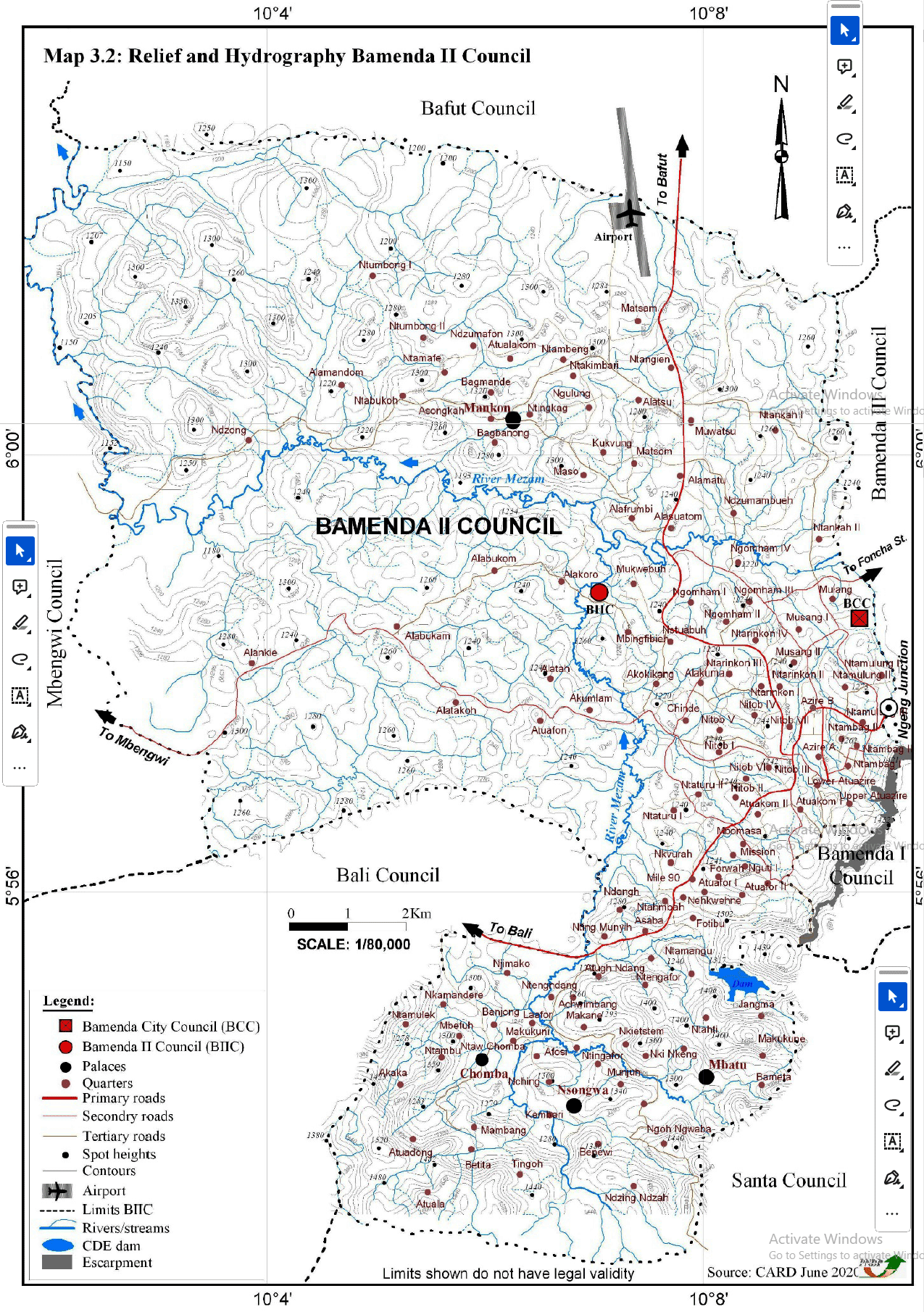
Assets Potentials and Constraints of Biophysical milieu:
Bamenda II Council is endowed with enormous resources and potentials as depicted in the Table below. The analysis of the natural site is to bring together the characteristics i.e. assets, potentials and threats of different features and various components of the natural site for planning purposes.
Assets Potentials and Constraints of Biophysical milieu (Source: CARD 2019 field Survey)
| Feature | Assets | Potentials | Threats |
| Climate | Cold tropical climate | - Has a dry and a rainy season | - Too windy - Torrential nature of rainfall - Heavy leaching of soils |
| Soils | Volcanic soils available | - Contain black quarries and laterite pits used for construction | - Heavy leaching around hill slopes |
| Vegetation | Forest, woodland and regrowth savannah | - Eucalyptus tree used for construction, electricity poles and as local fuel. | - Unsustainable management of forest resources - Biodiversity loose |
| Relief | Topography is undulating with some steep slopes | - Rich varied topography are main touristic sites | - Topography causes difficulty in farming |
| Hydrology | Available water bodies like streams, and small waterfalls | - Source of water for domestic use - Touristic site |
- Unsustainable management of water resources - Water pollution |
| Protected areas | Shrines | - Touristic sites - Preserve the cultural heritage |
- Its importance is fading away. |
| Mineral Resources | Availability of water bodies like streams. Stoney and sandy soil |
- Quarries for black stones used for construction - Sand |
- Poor management of these resources |
Forest and Fauna:
Limited poaching is carried out in the Council area. This is due to the fact that most of the forest cover has been drastically reduced thus destroying the habitat for most of the wildlife. No site or forest can today be used for hunting. However artisanal hunting is still widely practised, where rodents (cane rats, rabbits and other smaller wildlife) are still available in these forests (Mbatu, Chomba and Mankon palace forest). Forest exploitation is mainly of fuel plantation (eucalyptus) present in the entire Council area. They are exploited for local use (construction/furniture industries and energy-firewood).
A variety of animal species like antelopes, monkeys and deers were present in the council area but the encroachment of urbanization has pushed them away to a very limited number in the remote areas and fringes of the council. However, many farmers within the Bamenda II Council rear animals like pigs, goats, sheep, rabbits etc and these are used for consumption and commercial purposes thus providing an alternative source of income generation.
Protected Areas:
Areas in the Bamenda II Council that require protection include the Bamenda escarpment that cuts across from Jangma hills to Ntambag. Little attention has been made on the protection of the Bamenda escarpment.
There are watercourses which have been invaded by urbanization activities, although the building regulations/ code provides adequate setback for water courses, which are not respected. Few spring water catchments have been constructed and preserved for public use, and this effort needs to be intensified.
The CDE water retention dam that supplies urban water is experiencing encroachment from agricultural practices, cattle rearing, and other unfriendly human activities upstream. Community water catchments also suffer from the same number of human activities. In order to ensure safety of drinking water, measures are required to protect these sites.
Relief of The Bamenda II Council: