

Judicial and Institutional Framework of Gender
The term Gender encompasses the culturally and socially determined characteristics, values, norms, roles, attitudes and beliefs attributed by a society to women and men through constructed identity. Sex, on the other hand, refers to the biological difference between women and men. Gender, as a crosscutting construct, plays multiple roles in all aspects of development. The perception of gender determines the developmental role played by government institutions, the private sector, the civil society, rural and urban communities and other development partners.
A. National legal instruments: There are more than nineteen (19) national legal instruments enacted to guide gender policy, which include both general texts and those expressly designed to protect women in specific situations.
B. Institutional Framework: The national mechanism for gender promotion was established in 1975 in the Ministry of Social Affairs, which was later transferred to the Ministry of Women’s Affairs in 1984. After several transformations, the later ministry became the Ministry of Women’s Empowerment and Family (MINPROF) on the 8/12/2004.
Created by Decree N°2005/088 of 29/03/2005, MINPROF is responsible for drafting, implementing, and evaluating all measures relating to gender and the protection of the family. MINPROF works to ensure the elimination of all forms of discrimination based on sex, and guarantees the equitable inclusion of men and women in political, economic, social and cultural domains.
The institutional framework for implementing the national gender policy is made up of three committees i.e.
a) The inter-ministerial committee: Presided over by the Prime Minister, Head of Government.
b) Technical committee: Presided over by the Minister in charge of MINPROF.
c) Technical Secretariat: This is placed under MINPROF and presided over by the Secretary General of MINPROF; it holds quarterly meetings. Besides other entitlements, it is also responsible for continuous updates on gender issues.
GENDER SITUATION PER SECTION:
Gender Situation of Bamenda II Council as an Institution: The decentralization process presumes that public affairs and politics are initiated at the base and ensure equitable participation of men and women in domains such as the elective arm of government, the legislative arm of government, Public administration, etc. However, out of 30 councillors in Bamenda II Council, only
07 are women, out of 47 permanent council staff, only 19 are women and out of 24 temporary council staff, only 02 are women.
The above-mentioned situational analysis indicates that the Bamenda II Council as an institution has not attained the 30% minimum quota nationally allocated to women in decision-making and other institutions. The fact that the council institution has not elaborated a gender policy is contributory to this situation. The Bamenda II Council building has no provision for working, nursing mothers to bring their children to work as there is no kitchen and no nursery. Additionally, there are no ramps for the physically challenged of which there is such a councillor and some visitors doing business with the council have various impairments and challenges.
Organizations working on Gender Issues in Bamenda II: A number of NGOs (COMINSUD, Women's Forum, SIRDEP, Wa-Cameroon, CEDS, CHRAPA etc.), Associations and CBO’s have been working to integrate gender issues in institutions and in local traditional organisations. Most of their actions have been designed to create gender awareness, and ensure the integration of gender sensitivity into family and community life through gender analysis and the development of gender policies at grassroots level. Unfortunately, the council as an institution, though aware that Gender impacts all human activities, has neither developed a gender policy nor put in place any programme for training her staff and stakeholders on gender issues.
Men and Women in relation to Employment and Economic Opportunities: In the economic sphere, the domestic and employment profile of women and men will be at the formal/informal levels.
A. Domestic work
The division of labour in the villages within the municipality (Mankon, Nsongwa, Mbatu and Chomba) is biased against women, as it confines women mostly to reproductive roles, while men are engaged more in empowering productive roles.
B. Employment opportunities
The economic crises of the 1980s and 2008, and the ongoing Anglophones crises which began in 2016 have engendered an increase in the economic vulnerability of families within the Bamenda II municipality. Economic activities are carried out in Bamenda II sub-division, providing employment opportunities for both women and men, but more in the informal sector than in the formal.
C. Formal and informal sectors
The formal sector within the municipality falls under the jurisdiction of instruments governing gainful employment, while the informal sector lacks a normative framework despite its productivity.
# Formal sector: Civil Service General Rules and Regulations establish the principle of equality of access to all job markets, without any discrimination whatsoever based on gender. In Bamenda II municipality, the promotion of women in work places that exist is still low, regardless of the grade. Despite the legislative instruments available, women are still on the disadvantage with respect to the
distribution of positions of authority held in mixed socio-economic groups.
# Informal sector: The agricultural and non-agricultural informal sectors employ the bulk of the active population. More women than men perform activities in the informal agricultural sector, which is more dominant in the villages. On the other hand, the building construction and related fields engage more men than women. The women incur costs and expenses due to unavoidable work
absenteeism and incapacitation that result in low productivity. This sector also encompasses child labour, a situation which, in this particular case, refers to young children’s productive activities carried out outside their homes with or without payment.
D. Health
In the area of health, the population still suffers from endemic diseases (malaria, tuberculosis, etc.), the HIV/AIDS pandemic, and inadequate access to health care and medications. This is characterized by despicable gender disparities, particularly in reproductive health where many women continue to die during childbirth as a result of: - Inadequate healthcare services in the domains of family planning and contraception
- Low education that engenders ignorance of women’s human rights and existing remedies to women’s peculiar health problems
- Low income and generalised poverty
- Patriarchal socio-cultural norms that fuel gender-based violence
E. Education
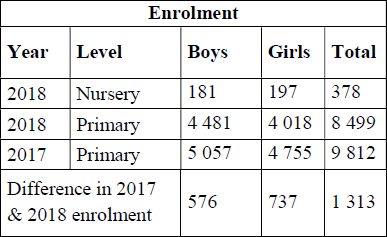
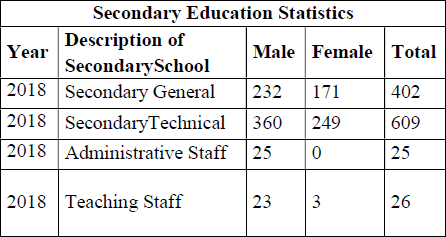
In Bamenda II Council area, the two educational systems operate (English and French systems). In addition, there is the non-formal system of education for young girls and boys, as well as inclusive education in GBHS Bamenda and at SENTTI developed for youths with special needs, notably children with disabilities.
School Enrolment Statistics in Bamenda II Municipality
GENDER AND TRANSVERSAL ISSUES:
Situation in decision-making and governance: There are different decision-making levels, for example, the family, public affairs and political levels.
Family level: Decision-making in households depends on the issues at stake and family status. Many women who take decisions by themselves are more likely to be single. In most cases, men fully enjoy their status as family heads and are at the centre of all major decisions.
Public Affairs and Political Levels: The decentralization process presumes that public affairs and politics are initiated at the base and ensure equitable participation of men and women in domains such as the elective arm of government, the legislative arm of government, Public administration, etc. However, out of 30 councillors in Bamenda II council, only 07 are women, out of 47 permanent council staff, only 19 are women, and less than 10% of the Sub-Divisional Delegations and other sub-divisional services are headed by women. Regarding the participation of men and women in Defence and Security Forces, the Bamenda II Military Base, the Gendarmerie Brigade, and other Public security services like the police are headed by men, with no sign of any female staff.
Gender-based Violence: Gender-based Violence (GBV) is a reality in Bamenda II municipality. Family members experience one form of violence or the other – be it domestic violence such as all forms of abuse, physical, sexual, emotional, psychological or economic violence. Socio-cultural norms lead to, and are factors of, Gender-based Violence.
Gender issues and consequences of HIV/AIDS: Bamenda II Council is at the gate-way into North West Region, the CBD of Bamenda, the regional, divisional and sub-divisional headquarters, is a transit town where many people move in and move out enroute to/from North West Region. Statistics show that HIV/AIDS is prevalent in the municipality. Research carried out by the North West Regional Technical group for HIV response on pregnant women in the North West Region from January to June 2017 showed a higher prevalence of the disease among the women than their husbands. Among these factors, and in the case of Bamenda II municipality, we may particularly highlight:
- Poverty that pushes young women and young men to engage in transactional sex,
- Mobility that tends to give people a legitimate feeling of (sexual) irresponsibility
- Peer pressure that engenders rural-to-urban migration, alcoholism and prostitution
- Ineffective care system due to multiple constraints faced by care givers, inadequate access to health care, etc.
Individual and group response to the pandemic; civil strife, disorder and war.
Gender issues in relation to the environment and climate change: Women in the municipality are more vulnerable to climate change because they are highly dependent on local natural resources, like forest flora and fauna and freshwater fish, for their livelihood. It is necessary to frequently emphasize the need for continuous education.
Recommendations: Priority actions to be carried out at the level of Bamenda II Council include, but not limited to:
- Liaising with more NGOs in order to build councillors and council staff capacities
- Making employment opportunities available to all with equity
- Institutionalising Gender policies and making them operational in the Council area
- Ensuring that Gender-based violence is addressed by all stakeholders in the Council area
- Enhancing the empowerment of families through poverty reduction strategies
- Vigorously pursuing health education and skills development as a mitigating factor.
- Developing a policy document on:
* Gender policies in major institutional setups in the Council area
* Gender trainings and capacity building (gender awareness creation, analysis, and gender integration)
* The programming of gender mainstreaming, complete with plans of action for the integration of gender concerns into every council programme or activity.
* A gender policy, an essential required institutional document be elaborated and the terms enforced in accordance with the provisions of the national gender policy.
* As a public office, infrastructural adjustments be made to accommodate all forms of people doing business with the council.